Choosing a Reusable Water Bottle You'll Actually Keep Using
Steel, glass, or plastic? The right bottle depends less on the trend of the moment and more on how you'll carry it, clean it, and use it.
- Words
- The Editors
- Reading
- 5 min
- Published
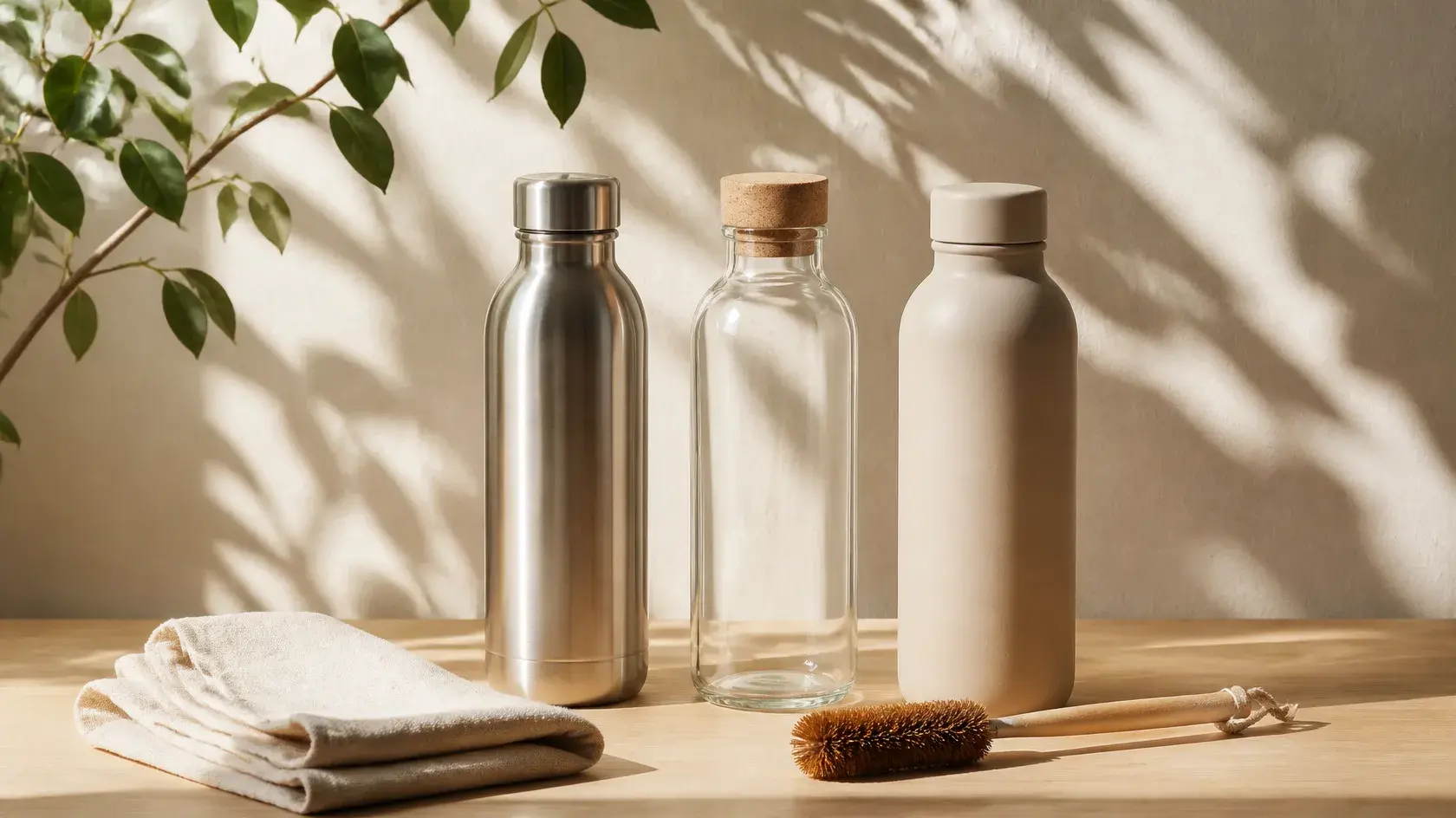
The best reusable bottle isn't the one everyone is carrying. It's the one you'll still be using next year.
Most of us already own a water bottle.
Possibly several. One leaks. One doesn't fit the car's cup holder. One smells faintly of something it held last spring.
Buying another feels simple. But the differences that matter aren't usually the ones in the advertising.
Begin with your actual day
Before choosing a material or a color, picture where the bottle will go.
Is it staying on your desk, or being thrown into a work bag? Do you need water to stay cold for hours, or just to be within reach? Are you carrying it one-handed on a commute?
A large insulated bottle is great in a car and irritating in a small bag. A slim glass bottle is pleasant at a desk and a risk on a hard floor.
As with most purchases, buy for the day you actually have.
Materials: what you're really choosing
Each common material involves a trade-off.
| Material | Strengths | Trade-offs |
|---|---|---|
| Stainless steel | Durable; can be insulated | Heavier; can dent; can't be seen through |
| Glass | Doesn't hold onto flavors easily; easy to inspect | Heavier; breakable |
| Hard plastic | Light and inexpensive; often clear | Can scratch and hold smells over time |
| Lined aluminum | Light | Dents; the lining's condition matters |
None of these is the right answer for everyone.
Steel suits people who are hard on their belongings. Glass suits people who mostly stay in one place. Plastic can make sense when weight comes first.
What "BPA-free" does and doesn't tell you
BPA is the label question most people ask about.
FDA states that BPA is safe at the current levels occurring in foods. Other researchers and regulators have raised concerns, and the debate hasn't ended.
"BPA-free" tells you one chemical was left out. It doesn't tell you much about the rest of the material.
University of Cincinnati researchers found in 2011 that BPA could migrate into water stored in polycarbonate bottles, while the alternatives they tested didn't show meaningful contamination under normal use. The lead author also pointed out that there were no standards for "BPA-free" claims.
If you'd rather sidestep the question, steel and glass are simple options. Check the lid too, since it's often plastic even when the body isn't.
Cleaning matters more than you'd expect
This is the least exciting part of owning a water bottle, and possibly the most important.
A reusable bottle is a food-contact surface. Refilling it isn't the same as cleaning it.
So before buying, look at how it comes apart:
- Mouth width: Can a brush or your hand get inside? Narrow openings are harder to scrub.
- Lid parts: Straws, valves, and gaskets are where residue tends to collect. Can you take them apart?
- Dishwasher guidance: Check the manufacturer's instructions, as some insulated bottles and lids are hand-wash only.
- Replacement parts: Can you buy a new gasket or lid, or does a worn part mean replacing the bottle?
If a bottle has parts you won't realistically clean, it isn't a practical purchase, however good it looks.
Wash it regularly and let it dry fully with the lid off. If plastic becomes deeply scratched, or a smell won't go away, it's time to replace it.
The details you only notice later
Small design choices shape daily use.
Lid type: Screw caps tend to be simple and easy to clean. Straw and flip lids are convenient for drinking, but have more parts.
Leak resistance: If it's going into a bag with a laptop, this matters more than anything else. Read reviews from people who've carried the bottle for months.
Fit: Check the diameter against your cup holder and bag pocket.
Weight: A full 32-ounce bottle holds about two pounds of water before you add the bottle itself.
Capacity: Bigger isn't automatically better. A bottle that's too heavy to carry stays at home.
Insulation is only worth it if you need it
Vacuum insulation keeps drinks cold or hot for hours. It also adds weight, bulk, and cost.
If you're outdoors in the heat or want your morning coffee to last, it's a real advantage.
If you sit at a desk near a tap, you may be paying for a benefit you won't notice.
And if you plan to carry hot drinks, confirm the bottle and lid are designed for them.
The water bottle checklist
Before buying, ask:
- Where will this bottle actually spend its day?
- Does the material suit how careful I am with my things?
- Can I clean every part of it?
- Will it stay leak-free in my bag?
- Does it fit my cup holder or bag pocket?
- Do I need insulation, or just a container?
And one more question: do you already own one that works?
If you do, the most sustainable bottle is probably the one in your cupboard.
Choose the bottle that fits your routine
A water bottle is a small purchase. That's why it's so easy to keep buying them.
A good one doesn't need to be impressive. It needs to fit your day, stay clean, and not leak on your laptop.
Buy for your routine. Check the lid. Wash it more than you think.
Sources & Further Reading
- U.S. Food and Drug Administration — Bisphenol A (BPA): Use in Food Contact Application
- University of Cincinnati — Research Shows "BPA-Free" Bottles Live Up to Manufacturers' Claims (2011)
Editorial note: This article offers general guidance and does not recommend specific products. Pick Kindly has not tested any products for this article, and no brand paid for placement. Read how we choose what to recommend.
Spotted an error or have a question about this piece? Write to the editors.