How to Choose Quality Supplements: What Actually Matters
More ingredients, higher doses, and bigger promises don't necessarily make a better supplement. Here's what deserves your attention.
- Words
- The Editors
- Reading
- 6 min
- Published

A supplement with 20 ingredients isn't necessarily better than one with three.
A $60 bottle isn't necessarily better than a $20 one. And a product described as clinically studied isn't necessarily proven to deliver the benefits printed on its label.
The supplement market offers plenty of information. The difficulty is knowing which information matters.
Before buying, there are five things worth examining.
1. Start With a Reason, Not a Recommendation
The first question isn't which brand to buy. It's whether you need a supplement at all.
Dietary supplements can help address certain nutritional needs. Vitamin B12, for example, deserves particular attention in vegan diets because it is not naturally present in unfortified plant foods in reliable amounts.
But a supplement being useful for one group doesn't mean everyone benefits from taking it.
Someone with an identified deficiency has a different reason to supplement than someone who simply wants more energy.
That distinction matters. Fatigue, poor sleep, and digestive discomfort can have multiple causes. A supplement marketed for those concerns may not address the underlying problem.
Before comparing products, identify what you're trying to achieve and whether supplementation is an appropriate way to achieve it.
If the answer isn't clear, buying something is unlikely to make it clearer.
2. Read the Amounts, Not Just the Ingredients
A supplement label can list impressive ingredients while revealing relatively little about the formula's usefulness.
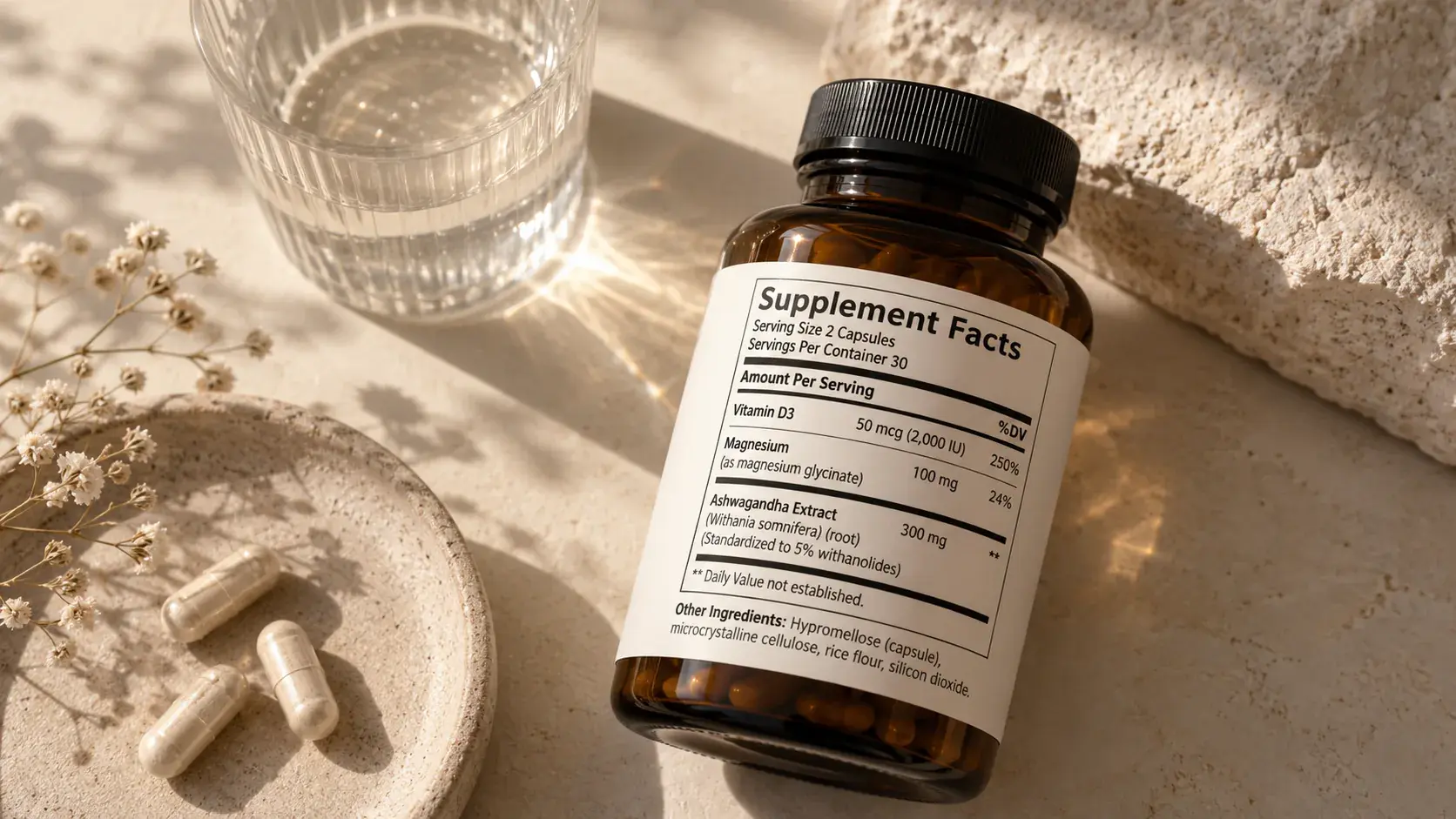
Start with the Supplement Facts panel.
Serving size. A bottle containing 60 capsules may provide only 30 servings if the recommended serving is two capsules.
Amount per serving. Two products can contain the same ingredient at very different amounts. The ingredient's presence alone tells you little about whether the dose is relevant.
Percent Daily Value (%DV). This shows how much a serving contributes to a reference daily intake for nutrients with established Daily Values. A higher percentage isn't automatically better. Excessive intake of certain nutrients can be harmful.
Other ingredients. Capsule materials, binders, and fillers are not inherently signs of poor quality. Still, they matter for people with allergies or dietary restrictions.
Then there are proprietary blends.
A product might list five ingredients under one blend and disclose only their combined weight. You know what's included, but not necessarily how much of each ingredient you're getting.
That makes the formula harder to evaluate.
More information on the front of a bottle doesn't always mean more transparency. The useful information is what allows you to assess the product.
3. Understand What the Evidence Actually Supports
Clinically studied sounds convincing.
But what was studied?
An individual ingredient? A specific dose? A particular group of people? Or the finished supplement being sold?
These distinctions are important.
Suppose a study investigates an ingredient at a certain dose and finds a benefit for a specific outcome. A product containing a smaller amount of that ingredient cannot automatically claim the same result.
The same problem appears when findings from one population are generalized to everyone.
A useful way to examine a supplement claim is to ask:
- Was the research conducted on the ingredient or the finished product?
- Was the studied amount comparable to the product's labeled dose?
- Did the study measure the benefit being advertised?
- Have the findings been supported by other credible research?
One positive study may be interesting. It isn't necessarily conclusive.
Also, natural doesn't mean risk-free. Plant-derived ingredients can have side effects and interact with medications.
In the United States, dietary supplements are not approved by the FDA for safety and effectiveness before they reach the market. Manufacturers are responsible for meeting applicable requirements, and the FDA has regulatory oversight.
A claim deserves attention because of the evidence behind it, not because of how confidently it's written.
4. Quality Testing and Effectiveness Are Different Questions
A supplement can contain exactly what its label promises and still provide little benefit for the purpose you're considering.
That isn't a contradiction.
Product quality concerns whether the supplement meets specifications for identity, composition, strength, purity, and other relevant characteristics.
Effectiveness concerns whether taking it produces a meaningful benefit.
These are different questions requiring different evidence.
In the United States, dietary supplement manufacturers must comply with applicable current Good Manufacturing Practice requirements. These rules establish manufacturing and quality-control standards.
Independent testing can provide additional assurance.
Programs associated with organizations such as USP and NSF may verify certain product-quality characteristics, including labeled contents and specified contaminant limits.
But certification doesn't mean a supplement is clinically effective or appropriate for everyone.
It's also worth checking whether a certification applies to the specific product rather than simply trusting a logo displayed on a brand's website.
A transparent manufacturer should make it reasonably easy to identify what a product contains, how it should be used, what warnings apply, and which quality claims can be verified.
If that information is difficult to find, it's reasonable to keep looking.
5. Compare Value, Not Just Price
Consider two hypothetical supplements.
| Product A | Product B | |
|---|---|---|
| Bottle price | $24 | $36 |
| Servings | 30 | 60 |
| Cost per serving | $0.80 | $0.60 |
Product B costs more upfront but less per serving.
That makes it potentially better value—if the formulas, ingredient amounts, and intended uses are reasonably comparable.
If they aren't, the calculation tells you very little.
A low price doesn't compensate for an unsuitable formula. A premium price doesn't establish superior quality.
The same applies to discounts.
A 30% discount on something you don't need is not a better purchase than choosing not to buy it.
Price becomes meaningful only after you've established that the product itself makes sense.
Before You Buy
A useful supplement decision comes down to five questions:
- Need: Is there a clear reason for taking it?
- Formula: Are the ingredients and amounts disclosed and appropriate?
- Evidence: Does credible research support its intended use?
- Quality: Can the manufacturer's quality claims be verified?
- Value: Is the price reasonable compared with suitable alternatives?
There's one more consideration: safety.
Supplements can cause adverse effects or interact with medicines. Some are unsuitable during pregnancy, before surgery, or for people with certain medical conditions. A healthcare professional can help evaluate individual risks and needs.
No checklist can guarantee that a supplement will work.
But it can help distinguish a product that provides useful information from one that mainly provides persuasive marketing.
And sometimes, after examining the evidence, the most reasonable choice is not to buy anything.
Sources & Further Reading
- NIH Office of Dietary Supplements — Dietary Supplements: What You Need to Know
- NIH Office of Dietary Supplements — Vitamin B12
- FDA — Questions and Answers on Dietary Supplements
- FDA — Dietary Supplement Labeling Guide
- NSF — Certified for Sport
Editorial note: This article provides general educational information, not individualized medical advice. Pick Kindly has not personally tested the products discussed in the hypothetical examples. No brand paid for placement in this article.
Spotted an error or have a question about this piece? Write to the editors.