How to Read a Supplement Facts Label (Without Getting Misled)
The front of a supplement bottle tells you what the brand wants you to notice. The Supplement Facts panel tells you what you can actually evaluate.
- Words
- The Editors
- Reading
- 6 min
- Published
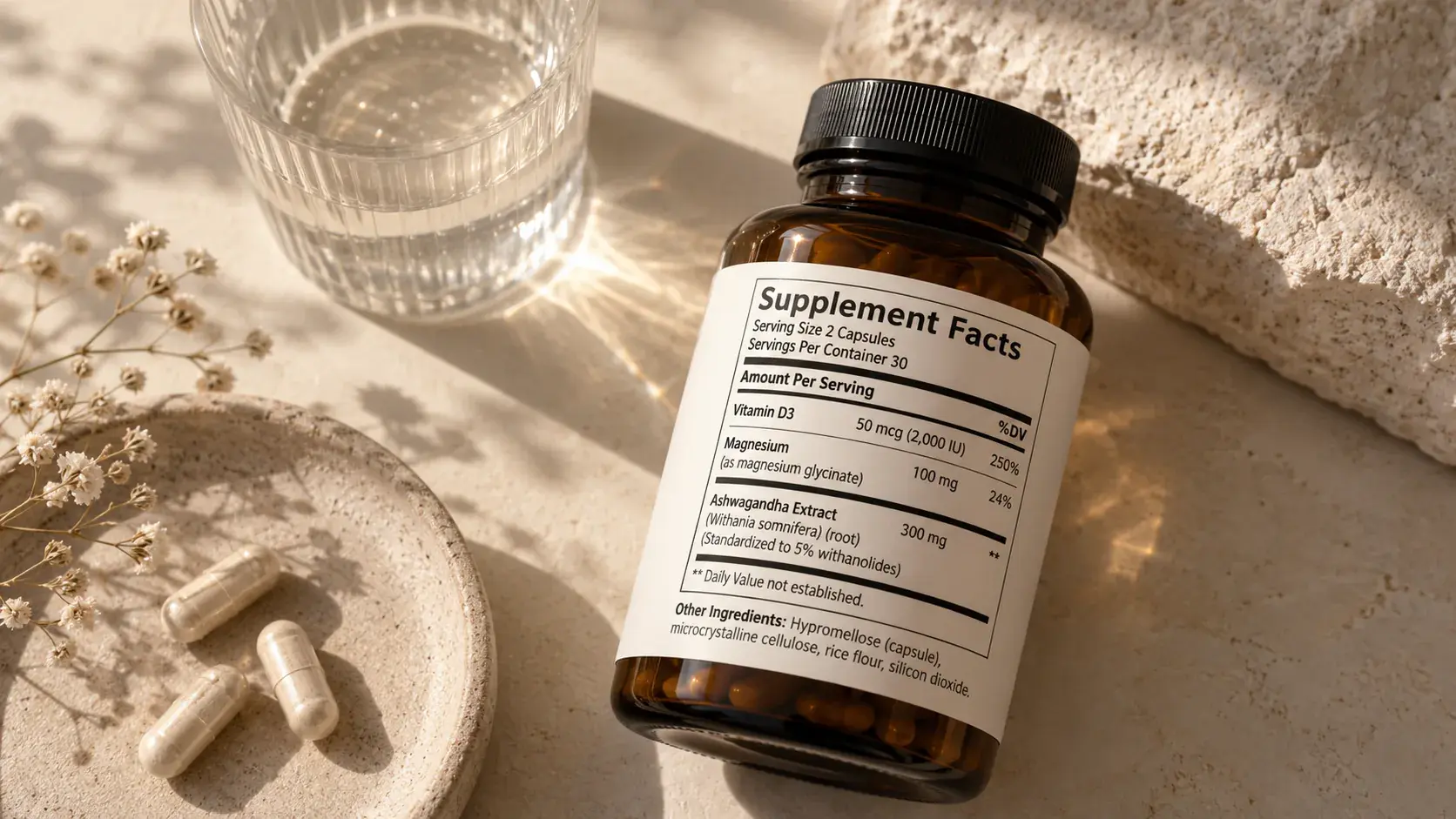
A supplement can promise better sleep, sharper focus, or stronger immunity in a few words.
Understanding what's inside usually takes longer.
The front label is designed to communicate a product's appeal. The Supplement Facts panel serves a different purpose: it discloses ingredients, amounts, and other information needed to evaluate the formula.
Neither tells the whole story. But knowing how to read the details makes it easier to separate useful information from persuasive marketing.
1. Start With the Serving Size
Before looking at any ingredient, check how much of the product counts as one serving.
Imagine a bottle containing 60 capsules. Its Supplement Facts panel lists:
| Label information | Example |
|---|---|
| Serving Size | 2 capsules |
| Servings Per Container | 30 |
| Vitamin C | 250 mg per serving |
The bottle contains 60 capsules, but the labeled amount of vitamin C applies to two capsules, not one.
If you take only one, you shouldn't assume you're getting the full 250 mg.
Serving size also affects cost. A $30 bottle with 30 servings costs $1 per serving, even though it contains 60 capsules.
The number of capsules on the front is useful for counting inventory. The serving size tells you how to interpret the formula.
2. Understand What % Daily Value Means
Next to many vitamins and minerals, you'll see a percentage labeled %DV.
Daily Value is a reference amount established for nutrition labeling. The percentage indicates how much of that reference amount one serving provides.
For example, the U.S. Daily Value for vitamin C for adults and children aged four and older is 90 mg.
A supplement containing 90 mg per serving therefore provides 100% DV.
That doesn't mean every individual needs exactly 90 mg daily. Personal requirements can vary with age, sex, pregnancy, and other circumstances.
It also doesn't mean that 500% DV is five times better than 100%.
Daily Value is a labeling reference, not a score for effectiveness.
For some nutrients, excessive intake can cause harm. When evaluating higher-dose supplements, compare the amount with relevant recommended intakes and tolerable upper intake levels, where established.
A large percentage should prompt a question, not automatically impress you.
3. Don't Confuse an Undisclosed Daily Value With an Unknown Dose
Some ingredients have an asterisk instead of a %DV.
The footnote may read:
Daily Value not established.
This means the FDA has not established a Daily Value for that ingredient.
It does not necessarily mean the ingredient is ineffective, unsafe, or unstudied.
And it doesn't mean the amount must be hidden.
For an individually listed dietary ingredient without an established Daily Value, the label generally still provides a quantity per serving.
Consider a hypothetical example:
| Ingredient | Amount Per Serving | %DV |
|---|---|---|
| Magnesium | 100 mg | 24% |
| Botanical Extract | 200 mg | * |
Daily Value not established for Botanical Extract.
The botanical extract's amount is disclosed. What isn't provided is a standardized Daily Value percentage.
Those are two different things.
The next question is whether 200 mg of that particular extract is meaningful, considering its identity, preparation, and supporting research.
A quantity becomes useful when you have something credible to compare it with.
4. Look More Closely at Proprietary Blends
A proprietary blend can make a label look detailed while limiting what you can learn from it.
Under U.S. labeling rules, a proprietary blend generally lists its total weight and identifies its component ingredients in descending order by weight. Individual amounts for the ingredients within the blend may not be disclosed.
Imagine a blend containing three botanical ingredients with a combined weight of 600 mg.
You know their order by weight. You don't know the precise amount of each one.
That matters if the evidence you're evaluating concerns a particular ingredient at a particular dose.
A study involving 300 mg of one extract doesn't establish that a blend containing an undisclosed amount of that extract delivers the same benefit.
Proprietary blends aren't automatically poor products.
But when two otherwise comparable formulas exist, the one disclosing individual ingredient amounts is generally easier to assess.
Transparency doesn't guarantee effectiveness. It makes evaluation possible.
5. Read the Other Ingredients List
The Supplement Facts panel isn't the entire ingredient list.
Look for Other Ingredients, where manufacturers disclose ingredients such as capsule materials, binders, colors, sweeteners, and flavorings that aren't already declared in the Supplement Facts panel.
These ingredients serve practical purposes. A capsule needs a shell; some formulas need materials that help with manufacturing or stability.
Their presence alone doesn't make a supplement inferior.
What matters is whether they create a problem for your needs.
Someone avoiding animal-derived gelatin, for example, may need to check the capsule material. Someone with a particular allergy may need to examine the full ingredient list and relevant warnings.
An ingredient's unfamiliar name is not evidence that it's harmful.
Equally, a short ingredient list is not proof that a product is safer.
The goal is to understand what you're consuming, not to reward whichever label looks simplest.
6. Read Marketing Claims as Claims, Not Conclusions
Turn the bottle around again.
You may see phrases such as:
- Supports immune health
- Promotes relaxation
- Clinically studied
- Natural formula
These phrases don't all mean the same thing.
In the United States, certain statements about supporting normal body structure or function can appear on dietary supplement labels without FDA preapproval. Manufacturers must have substantiation for covered claims and meet applicable notification and disclaimer requirements.
You may recognize the disclaimer:
This statement has not been evaluated by the Food and Drug Administration.
That disclosure is important, but it isn't a verdict on whether the product works. It means the particular statement hasn't been evaluated by the FDA.
Likewise, clinically studied raises a question rather than answering one.
Was the finished product studied? Or was the research conducted on an ingredient that happens to appear in the formula?
Was the amount comparable? Were the participants and measured outcomes relevant?
A study's existence and a product's demonstrated benefit are not interchangeable.
7. Know What the Label Cannot Tell You
Even a clearly labeled supplement leaves important questions unanswered.
The Supplement Facts panel doesn't establish whether a product will improve your health, whether its ingredients are appropriate for you, or whether the finished product has undergone independent quality testing.
Those questions require additional evidence.
A useful label allows you to identify the formula. Research helps you assess whether that formula makes sense. Quality documentation can provide further information about manufacturing and testing.
And your individual circumstances determine whether using it is appropriate.
These aren't competing sources of information. They answer different questions.
A 30-Second Label Check
Before buying, look for five things:
- Serving size: How many capsules, tablets, or scoops make one serving?
- Ingredient amounts: Are the quantities clear enough to evaluate?
- %DV: Are you interpreting the percentage as a reference value rather than a benefit score?
- Other ingredients: Is there anything relevant to your allergies, dietary restrictions, or preferences?
- Claims: Can you distinguish what the label says from what credible evidence actually supports?
If an important detail is missing, check the manufacturer's documentation or ask for clarification before purchasing.
A supplement label doesn't need to be impressive.
It needs to give you enough reliable information to make an informed choice.
Sources & Further Reading
- FDA — Dietary Supplement Labeling Guide: Nutrition Labeling
- FDA — Questions and Answers on Dietary Supplements
- FDA — Structure/Function Claims
- NIH Office of Dietary Supplements — Dietary Supplements: What You Need to Know
- NIH Office of Dietary Supplements — Background Information: Dietary Supplements
Editorial note: This article provides general educational information about U.S. dietary supplement labels, not individualized medical advice. All example labels and ingredient combinations are hypothetical and are not representations of commercial products. No brand paid for placement in this article.
Spotted an error or have a question about this piece? Write to the editors.