How to Build a Skincare Routine That Actually Makes Sense
A thoughtful guide to what your skin needs, what it might benefit from, and what you can probably skip.
- Words
- The Editors
- Reading
- 8 min
- Published

Somewhere along the way, skincare became complicated.
A cleanser turned into a double cleanse. A moisturizer became a collection of serums. And a simple morning routine somehow grew into a ten-step commitment, complete with ingredients you might not understand and products you may not actually need.
But more skincare doesn't necessarily mean better skin.
A thoughtful routine starts with a simpler question: What does my skin need, and what am I trying to change?
The answer is different for everyone. But the principles behind a good routine are surprisingly straightforward.
Start with the essentials
Before considering exfoliating acids, retinoids, or the latest trending serum, build a routine around three fundamentals.
1. A gentle cleanser
Cleansing removes dirt, excess oil, and other residue that collects on the skin throughout the day.
For most people, a gentle cleanser is a sensible starting point. It should leave your skin feeling clean, not tight or uncomfortable.
If your skin feels stripped after washing, that isn't necessarily a sign the cleanser is working harder. It may simply be too harsh for your skin.
Look for a formula that suits your skin's needs, and avoid assuming that a stronger cleanser will automatically produce better results.
2. A moisturizer that supports your skin barrier
Your skin barrier helps limit water loss and protect against external irritants.
Moisturizers work in different ways. Humectants, such as glycerin, attract and retain water. Emollients help soften the skin, while occlusive ingredients help reduce moisture loss.
A lightweight lotion may be enough for some people. Others may feel more comfortable with a richer cream.
The goal isn't to find the most expensive moisturizer. It's to find one your skin tolerates and that provides enough hydration.
3. Broad-spectrum sunscreen
If there is one step worth making a daily habit, it's sun protection.
The American Academy of Dermatology recommends choosing a broad-spectrum sunscreen with SPF 30 or higher and water resistance, alongside other sun-protective measures.
Sunscreen helps protect against ultraviolet radiation, which contributes to sunburn, premature skin aging, and skin cancer.
The best sunscreen for your routine is one you can wear consistently and apply properly.
And remember: no sunscreen offers complete protection. Shade and protective clothing still matter.
Morning vs. evening: what actually changes?
Your morning routine and evening routine don't need to be identical.
Morning
- Gentle cleanse, if needed
- Moisturizer
- Broad-spectrum SPF 30+
Evening
- Gentle cleanse
- Targeted treatment, if appropriate
- Moisturizer
Some people with dry or sensitive skin prefer simply rinsing with water in the morning. Others benefit from a gentle cleanser, particularly if their skin is oily.
At night, cleansing is useful for removing sunscreen, makeup, and the day's buildup.
Double cleansing can help remove certain long-wearing products, but it isn't a universal requirement. If one gentle cleanser removes your makeup and sunscreen effectively, a second cleanse may add little benefit.
The most useful routine is one that fits your skin and your life.
Understand your skin before adding products
Skin types can be useful starting points, but they aren't permanent identities.
Your skin may change with the seasons, age, environment, medications, or hormonal fluctuations.
| Skin concern | What to prioritize |
|---|---|
| Dryness | Gentle cleansing, richer moisturizers, ingredients that help reduce water loss |
| Oiliness | Lightweight, non-comedogenic products and gentle cleansing |
| Sensitivity | Fragrance-free options, fewer new products, careful introduction |
| Acne-prone skin | Non-comedogenic products and evidence-based acne treatments when needed |
| Combination skin | Adjusting texture or moisturizer amount for different areas |
A product labeled “for oily skin” isn't automatically right for every oily-skinned person. And a product designed for sensitive skin isn't guaranteed to be irritation-free.
Pay attention to how your skin responds, not just the label on the packaging.
If you experience persistent acne, eczema-like symptoms, rosacea, or significant irritation, a dermatologist can help identify the underlying problem rather than relying on trial and error.
When should you add an active ingredient?
Once your basic routine is comfortable and consistent, you can consider targeted treatments.
But every active ingredient should have a reason to be there.
Retinoids: for acne and signs of photoaging
Retinoids are vitamin A derivatives used in skincare. Depending on the specific ingredient and formulation, they may help with acne, fine lines, and uneven skin texture.
They can also cause dryness, peeling, and irritation, especially when first introduced.
Start cautiously, follow the product directions, and consider professional guidance if you're managing a skin condition.
Retinoids are generally avoided during pregnancy or when trying to conceive; consult a healthcare professional about appropriate alternatives.
Exfoliating acids: for specific texture and congestion concerns
Alpha hydroxy acids (AHAs), such as glycolic and lactic acid, exfoliate the skin's surface. Beta hydroxy acid (BHA), commonly salicylic acid, can be useful for certain acne and clogged-pore concerns.
But exfoliation is not a daily obligation.
Overuse may lead to irritation, dryness, and a disrupted skin barrier. Some exfoliating acids, particularly AHAs, can also increase sensitivity to sunlight.
If your skin is already irritated, adding another exfoliant is unlikely to help.
Vitamin C: for a targeted antioxidant approach
Vitamin C is commonly used in skincare for its antioxidant properties and potential role in improving the appearance of uneven pigmentation.
However, performance depends on formulation, concentration, stability, and how the product is used.
A Vitamin C serum isn't necessary for everyone, and an expensive formula isn't automatically more effective.
If your basic routine is working well, there's no reason to add one simply because it's popular.
How to introduce a new product without overwhelming your skin
The excitement of starting a new routine can make it tempting to change everything at once.
But when several products are introduced together, it becomes difficult to identify which one is helping—or causing irritation.
A more thoughtful approach:
- Introduce one new product at a time.
- Patch-test when appropriate, especially if your skin is reactive.
- Follow the product's recommended frequency and application instructions.
- Monitor for persistent redness, burning, itching, or worsening irritation.
- Give suitable products enough time to work, while stopping anything that causes a concerning reaction.
The AAD provides guidance on testing skincare products before incorporating them into a routine. It suggests applying a new product to a small test spot twice daily for seven to ten days before regular use, leaving it on for as long as you normally would. For rinse-off products, such as cleansers, that means about five minutes or as long as the product's instructions say.
And remember that not all reactions are normal adjustment periods. Persistent burning or significant irritation shouldn't be dismissed as evidence that a product is working.
Five skincare habits worth reconsidering
1. Buying products before identifying a concern
A product can be well formulated and still be unnecessary for you.
Before purchasing something new, ask what specific purpose it would serve in your existing routine.
2. Assuming more steps mean better results
A complicated routine creates more opportunities for ingredient overlap, irritation, and inconsistency.
A short routine used regularly may be more useful than an elaborate one you struggle to maintain.
3. Following ingredient trends without understanding formulations
An ingredient's reputation doesn't tell you everything about a finished product.
Concentration, formulation, packaging, and compatibility all influence how a product performs.
4. Changing products too quickly
Some skincare benefits take weeks to become noticeable.
Switching products constantly makes it difficult to evaluate results, although irritation or other concerning symptoms are reasons to stop rather than wait.
5. Treating skincare as a competition
Someone else's ten-step routine isn't a benchmark for your skin.
Your skin doesn't need to look like an advertisement to be healthy.
How to decide whether a product is worth buying
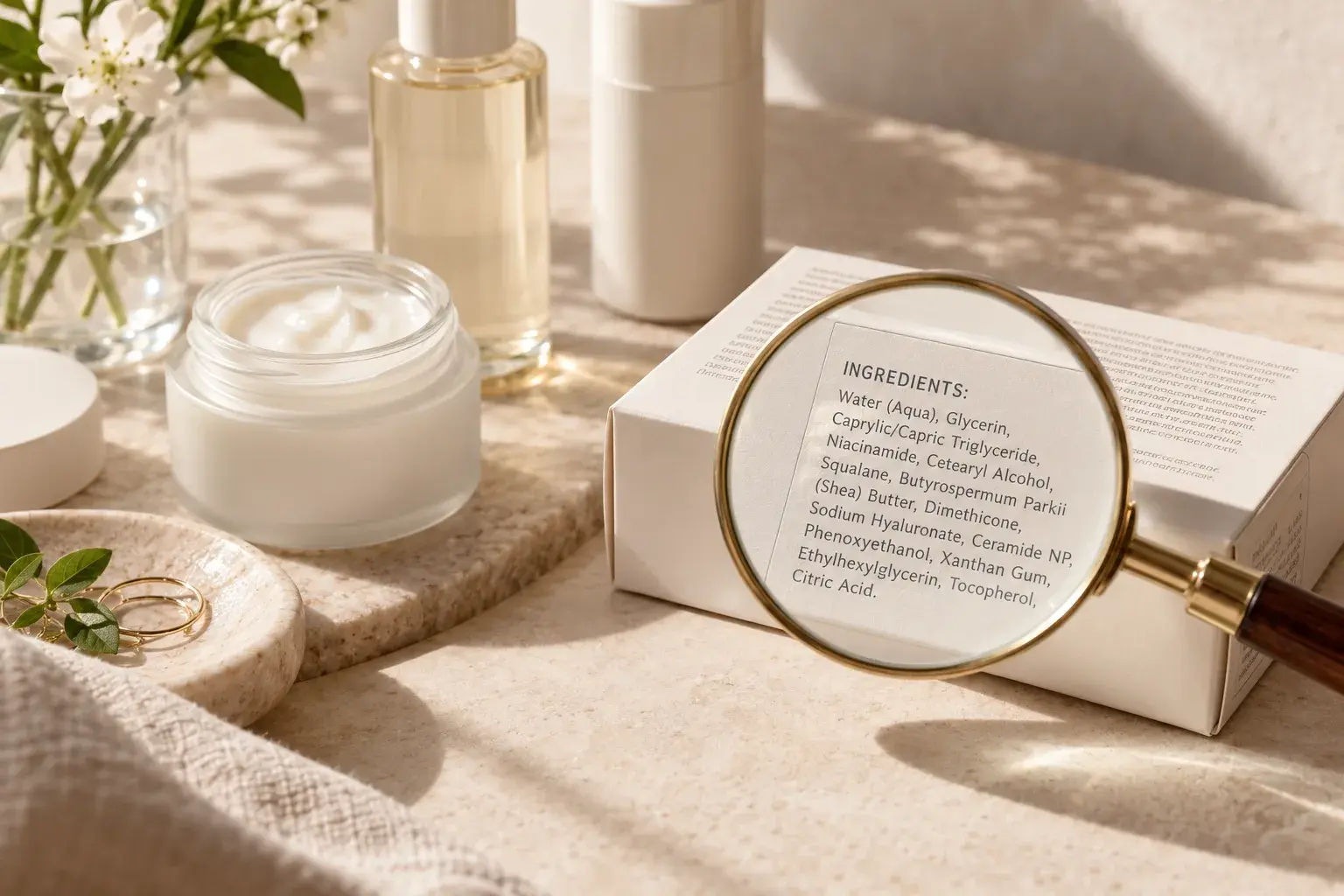
Before adding another product to your shelf, consider five questions:
- Purpose: What specific concern is this product intended to address?
- Evidence: Is there credible support for its ingredients or claimed benefits?
- Compatibility: Does it fit your skin's needs and current routine?
- Practicality: Can you use it consistently and as directed?
- Value: Does it offer something meaningful that your existing products don't?
This doesn't mean every skincare purchase needs to be purely functional. Enjoying a texture, fragrance, or beautiful packaging can be part of the experience.
But it's worth knowing whether you're buying a product because it meets a need or simply because it caught your attention.
Both can be conscious choices. They just aren't the same choice.
A better routine is one you can actually maintain
Good skincare isn't about collecting the most products or following every new recommendation.
It's about understanding what matters, choosing products with intention, and giving your skin the consistency it needs.
Start with the essentials. Add treatments when there's a clear reason. Pay attention to how your skin responds.
And remember that sometimes the most thoughtful addition to your routine is choosing not to add anything at all.
Fewer steps. Better reasons. A routine that makes sense for you.
Sources & Further Reading
- American Academy of Dermatology — Skin Care on a Budget
- American Academy of Dermatology — Sunscreen FAQs
- American Academy of Dermatology — Practice Safe Sun
- American Academy of Dermatology — How to Test Skin Care Products
- American Academy of Dermatology — Acne: Tips for Managing
- American Academy of Dermatology — Retinoid or Retinol?
- American Academy of Dermatology — Dermatologist-Approved Pregnancy Skin Care
- FDA — Alpha Hydroxy Acids
Editorial note: This article provides general educational information about skincare, not individualized medical advice. If you have a skin condition, are pregnant, or are trying to conceive, speak with a dermatologist or other healthcare professional. Pick Kindly has not tested any products for this article. No brand paid for placement in this article.
Spotted an error or have a question about this piece? Write to the editors.