How to Read a Skincare Ingredient List (Without Getting Overwhelmed)
A practical guide to understanding what’s in your skincare, what the label can tell you, and what it can’t.
- Words
- The Editors
- Reading
- 7 min
- Published
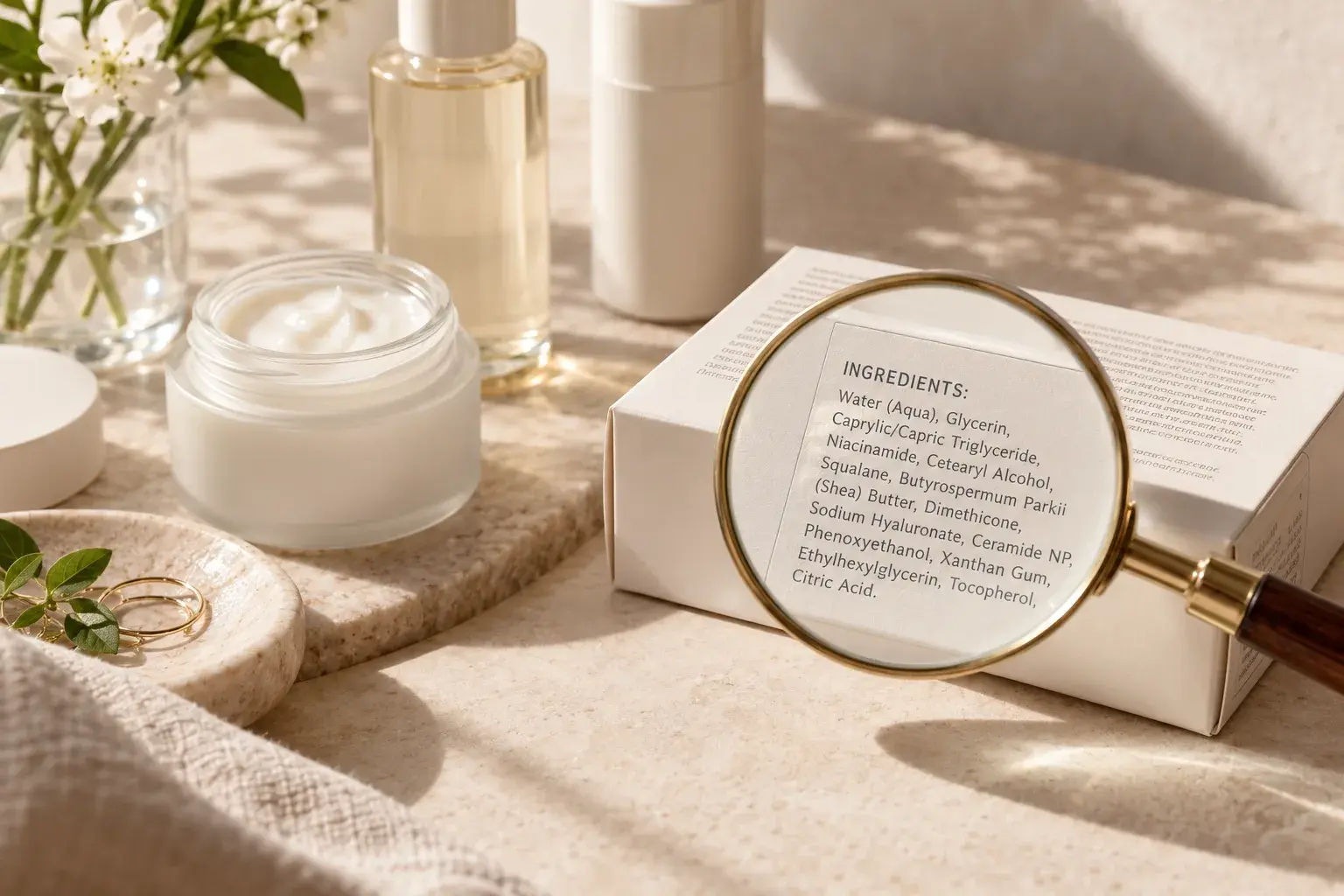
Turn over almost any skincare product, and you'll find a list of words that can feel more like a chemistry exam than something meant to help you shop.
Some are familiar: water, glycerin, shea butter. Others look intimidating, even when they're ordinary ingredients used to keep a formula stable, comfortable, or effective.
It's tempting to believe that a shorter list is better, that natural ingredients are always gentler, or that anything difficult to pronounce should be avoided.
But none of those assumptions tells you whether a product is right for your skin.
An ingredient list is a useful starting point. It isn't the whole story.
Here's how to read one with more confidence—and less unnecessary worry.
1. Start with the ingredient order
In the United States, cosmetic ingredients are generally listed in descending order of predominance.
But there's an important exception: ingredients present at concentrations of 1% or less may be listed in any order after those present above 1%. Color additives follow additional rules.
This means an ingredient near the beginning is generally present in a larger amount than ingredients listed later in the above-1% portion of the list.
What it doesn't mean is that you can calculate exact concentrations from ingredient order.
A familiar ingredient appearing near the bottom isn't automatically ineffective. Some ingredients are useful at relatively low concentrations.
What the list tells you: which ingredients are declared and their order under applicable labeling rules.
What it doesn't tell you: exact percentages, stability, effectiveness, or how your skin will respond.
Think of it as a map—not a complete product evaluation.
2. Learn what ingredients actually do
You don't need to memorize hundreds of chemical names. Understanding a few ingredient categories is much more useful.
| Ingredient type | Common examples | Primary purpose |
|---|---|---|
| Humectants | Glycerin, hyaluronic acid | Help attract and retain water |
| Emollients | Squalane, certain fatty alcohols | Soften and smooth skin |
| Occlusives | Petrolatum, dimethicone | Help reduce moisture loss |
| Cleansing agents | Cocamidopropyl betaine and other surfactants | Help remove oil and residue |
| Preservatives | Phenoxyethanol, sodium benzoate | Help control microbial contamination in suitable formulas |
| Stabilizers and thickeners | Carbomer, xanthan gum | Help maintain texture and consistency |
| Fragrance ingredients | Fragrance/parfum, aromatic compounds | Add or modify scent |
These roles aren't mutually exclusive. One ingredient may perform several functions.
And not every ingredient is included to deliver a visible skincare benefit.
Preservatives, emulsifiers, and stabilizers help make a product practical to use. Their presence isn't evidence of poor quality.
A thoughtful formula is more than a collection of fashionable ingredients.
3. Don't confuse natural with safe—or scientific with harmful
A complicated ingredient name can sound intimidating.
Tocopherol, for example, is a form of vitamin E. Sodium hyaluronate is a salt form of hyaluronic acid.
Neither name tells you whether the finished product will work well for your skin.
Likewise, an ingredient derived from plants isn't automatically gentle. Some essential oils and botanical extracts can trigger irritation or allergic reactions.
The familiar distinction between “natural” and “chemical” skincare is misleading. Water, plant oils, and synthetic compounds are all chemicals.
More useful questions include:
- What does this ingredient do?
- Is it suitable for the product's intended use?
- Is there evidence supporting the claimed benefit?
- Have I reacted to this ingredient before?
An ingredient's origin or name is not a substitute for evaluating its safety and suitability.
4. Look beyond the star ingredient
A moisturizer might highlight ceramides. A serum might emphasize niacinamide. Another product might advertise hyaluronic acid across the front of its packaging.
These ingredients can serve useful purposes.
But the headline ingredient isn't the entire formula.
Glycerin and hyaluronic acid are commonly used to support hydration. Ceramides are components of the skin's natural barrier. Niacinamide is used in formulas targeting several skin concerns.
Still, seeing these names on a label doesn't prove that a product is effective.
Performance can depend on concentration, formulation, stability, packaging, and how the product is used.
Two products containing the same highlighted ingredient may feel and perform differently.
And a less expensive moisturizer with a well-designed formula may be a better choice than a costly serum built around a trending ingredient.
Judge the product—not just its most marketable component.
5. Understand what the label cannot prove
Ingredient lists are valuable, but they have limits.
Exact concentrations
Most cosmetic labels don't disclose the percentage of every ingredient. Unless the manufacturer provides additional information, ingredient order alone cannot reveal the complete formula.
Clinical effectiveness
An ingredient may have supporting research without the finished product having been tested for the same outcomes.
Evidence for an ingredient isn't automatically evidence for every formula containing it.
Personal compatibility
Even a thoughtfully formulated product can cause irritation or an allergic reaction.
Your skin condition, known sensitivities, and existing routine matter.
Safety from a numerical score
Ingredient-rating apps can help identify substances worth researching, but a single score rarely captures concentration, exposure, formulation, and intended use.
Use those tools as starting points, not final verdicts.
6. Read marketing claims with a little skepticism
Some of the most persuasive words on skincare packaging are also the least informative without context.
“Clean beauty”
There is no single FDA-defined standard for what makes a cosmetic product “clean.” Brands and retailers may use different criteria.
“Natural”
Natural origin doesn't guarantee that an ingredient is safer, gentler, or more effective.
“Dermatologist tested”
The phrase alone doesn't explain what was tested, how the study was conducted, or what the results showed.
“Hypoallergenic”
The FDA has no federal standard defining this cosmetic claim. It doesn't guarantee that a product won't cause an allergic reaction.
“Fragrance-free” and “unscented”
These terms aren't necessarily interchangeable. An unscented product may contain ingredients used to mask odors. If you have a fragrance allergy, review the ingredient information rather than relying on the front label alone.
Marketing language can provide clues, but meaningful details matter more.
7. A five-minute ingredient-list check before buying
You don't need to become a cosmetic chemist to make more informed choices.
Try these five questions.
1. What is this product supposed to do?
A cleanser, moisturizer, and acne treatment serve different purposes. Start by identifying the job you're asking the product to perform.
2. Do the ingredients make sense for that purpose?
Look for relevant ingredient groups rather than assuming the most advertised ingredient is the most important.
3. Is there anything my skin may not tolerate?
Known allergies, previous reactions, and existing skin conditions deserve more attention than generic ingredient rankings.
4. Are the marketing claims meaningful?
Look for specific evidence behind claims such as “clinically tested” or “dermatologist recommended.”
5. Does this product add something useful to my routine?
Consider price, practicality, formulation, and whether your current products already meet the same need.
Sometimes the most sensible decision is to buy nothing.
8. Know when the label requires a different approach
Not every skincare product in the United States is regulated solely as a cosmetic.
Sunscreens and certain acne treatments are regulated as drugs, or as both drugs and cosmetics, depending on their intended uses and claims.
These products may carry a Drug Facts panel identifying active ingredients and directions. Don't interpret that panel as though it were an ordinary cosmetic ingredient list.
And if you have a diagnosed contact allergy, persistent skin condition, or concerns about treatments during pregnancy, professional guidance may be more useful than ingredient-list research alone.
A better question than “Is this ingredient good?”
Skincare ingredients don't fall neatly into two categories: good and bad.
An ingredient can be useful in one formula and unnecessary in another. A product can contain several well-researched ingredients and still be wrong for your skin.
Understanding the label won't answer every question.
But it can help you recognize what matters, question vague promises, and make more deliberate choices.
Read the label. Understand the context. Buy with intention.
Because choosing well is more useful than choosing more.
Sources & Further Reading
- U.S. FDA — Cosmetic Ingredient Names
- U.S. FDA — Summary of Cosmetics Labeling Requirements
- U.S. FDA — “Hypoallergenic” Cosmetics
- U.S. FDA — Fragrances in Cosmetics
- U.S. FDA — Is It a Cosmetic, a Drug, or Both? (Or Is It Soap?)
- American Academy of Dermatology — Skin Care Basics
Editorial note: This article provides general educational information about U.S. cosmetic labeling, not individualized medical advice. The ingredient list shown in the hero image is an illustrative example, not a real product label. Pick Kindly has not tested any products for this article. No brand paid for placement in this article.
Spotted an error or have a question about this piece? Write to the editors.