Choosing an Air Purifier That Fits Your Room
CADR, filters, noise, and upkeep: what actually matters when you're comparing air purifiers, and what they can't do for you.
- Words
- The Editors
- Reading
- 5 min
- Published
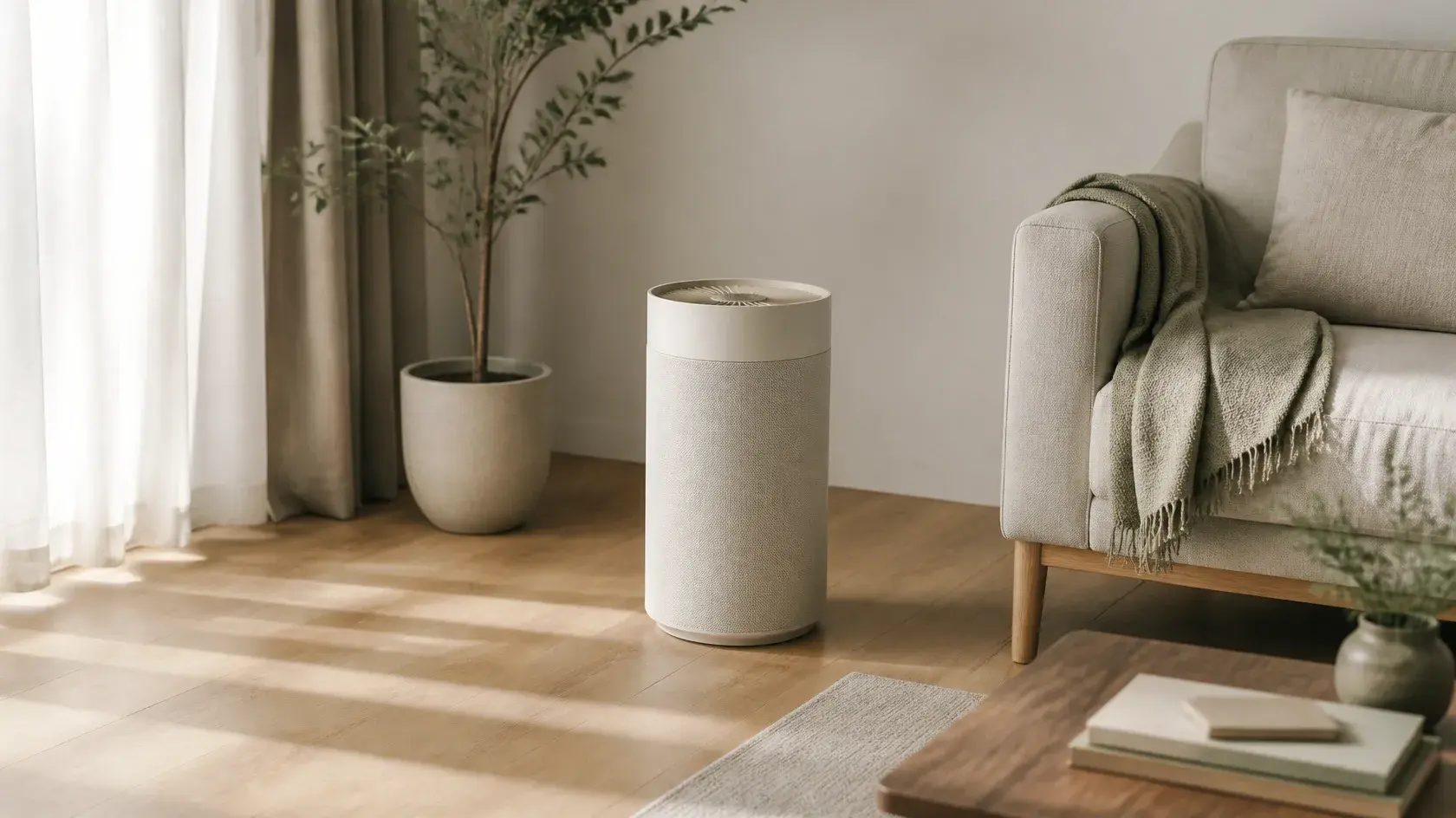
A good air purifier is sized for your room, quiet enough to leave on, and honest about its limits.
Air purifiers are easy to want and hard to compare.
One promises hospital-grade air. Another lists seven stages of filtration. A third connects to an app that turns a small circle from orange to green.
None of that tells you the first thing you need to know: can this machine clean the air in the room you'll actually use it in?
Start with what's in your air
Before comparing machines, identify the problem.
Dust, pollen, pet dander, and smoke are mostly a particle problem. Odors and fumes from cooking, cleaning products, or fresh paint are largely a gas problem.
The difference matters, because the EPA notes that most filters target one type of pollutant.
A machine that performs well against particles may do little for a smell.
Remember what it can't do
The EPA is direct about this: "No air cleaner or filter will eliminate all of the air pollutants in your home."
It describes filtration as a supplement to the two most effective approaches: reducing the source of the pollution, and ventilating with clean outdoor air.
So if the problem is a leaking gas appliance, a mold patch, or a musty basement, a purifier isn't the fix.
Deal with the cause first. Then decide whether filtering the air would still help.
CADR is the number to compare
CADR stands for Clean Air Delivery Rate. It's a measure of how much filtered air a portable purifier delivers, tested against smoke, dust, and pollen.
It's more useful than most of what's on the box.
According to the EPA, the higher the CADR, the more particles the unit can filter and the larger the area it can serve.
Here's how to use it:
- Measure your room. Multiply length by width to get the floor area.
- Check the stated room size. Packaging usually lists the largest room the unit suits.
- Compare the CADR figures. Between two units for the same room, a higher number means more filtered air.
- Allow for higher ceilings. A taller room holds more air, so consider a size up.
The AHAM Verifide program certifies CADR ratings, so look for its mark when you're comparing claims.
Be wary of a machine that advertises a large room size but doesn't publish a CADR at all.
Filters: particles and gases need different things
A filter's name is a starting point, not the whole answer.
A CADR rating tells you how the whole machine performs against particles, which is more useful than a filter label alone.
Gases are harder. The EPA says to look for an activated carbon filter, or another filter designed to remove gases, if that's your concern. It also notes that no widely used rating system exists for gas-removal filters.
That means gas claims are harder to verify. Be cautious with strong promises about odors or chemicals, particularly when a unit contains only a thin layer of carbon.
Avoid anything that makes ozone on purpose
This is the one firm rule in this guide.
The EPA advises avoiding air cleaners that intentionally produce ozone, because ozone is a lung irritant. Its page on ozone generators says inhaled ozone can damage the lungs, and that ozone has little potential to remove indoor contaminants at concentrations that meet public health standards.
Watch for the words "ozone generator," and be skeptical of vague promises about "energized" or "purified" oxygen.
Some other technologies, including certain ionizers, can release small amounts of ozone as a byproduct. The EPA points to lists from the California Air Resources Board and AHAM to help you find low-ozone devices.
Noise decides whether you'll use it
A purifier only works when it's on.
The EPA notes that noise depends partly on fan speed, and that some units publish noise ratings. The catch is obvious: the speed that earns a high CADR is often the loudest.
Think about where it will sit.
In a bedroom, how it sounds on low matters most. In a living room, you can run it higher when you're out. If a published noise figure is available, check which fan speed it refers to.
A machine you turn off because it's annoying isn't cleaning anything.
Calculate the cost after checkout
The purchase price is only the beginning.
The EPA says all filters need regular replacement, and that manufacturers often suggest changing them every 60 to 90 days, or sooner if they look heavily soiled. Intervals vary by model, so check the manual.
Before you buy, look up:
- The price of a replacement filter
- How often the manufacturer suggests replacing it
- Whether third-party or only branded filters are available
- Whether you can still buy the filter if the model is discontinued
- How much electricity it uses at the speed you'd actually run
As with most home essentials, a cheap machine with costly consumables may not be cheap for long.
Don't pay extra for features you won't use
Air-quality sensors can be useful, particularly if they adjust the fan automatically. Apps, voice control, and color displays are mostly about convenience.
None of them cleans the air.
If two machines have similar CADR ratings, filter costs, and noise levels, you don't need to pay more for a nicer screen.
The air purifier checklist
Before buying, ask:
- What am I trying to remove: particles, gases, or both?
- Have I dealt with the source and ventilation first?
- Is the unit rated for my room, with a published CADR?
- Does it avoid intentionally producing ozone?
- Will I tolerate the noise at the speed I'll need?
- What will filters cost me each year?
Clean air starts before the machine
An air purifier can be a genuinely useful tool.
But it works best as the last step, not the first: remove what you can, let fresh air in when it's clean, and filter what remains.
Measure the room. Compare the CADR. Skip the ozone.
Sources & Further Reading
- U.S. Environmental Protection Agency — Guide to Air Cleaners in the Home
- U.S. Environmental Protection Agency — Air Cleaners and Air Filters in the Home
- U.S. Environmental Protection Agency — Ozone Generators that are Sold as Air Cleaners
- AHAM Verifide — Air Cleaner Certification Program
Editorial note: This article offers general guidance and does not recommend specific products. It is not medical advice; if you have asthma or another respiratory condition, speak with a healthcare professional. Pick Kindly has not tested any products for this article, and no brand paid for placement. Read how we choose what to recommend.
Spotted an error or have a question about this piece? Write to the editors.